Preface
ProFacet was created for cutters who want to understand every facet of their craft. That vision led to FSL—a new faceting specification language shaped by practical experience and refined through collaboration with expert designers and gem cutters.
Standard Faceting diagrams show you the result of the design, but not the path to get there or how to adapt when things change. It’s like the difference between a photo of a cake and the recipe behind it. FSL gives you the recipe—the structure and freedom to recreate, adjust, and invent.
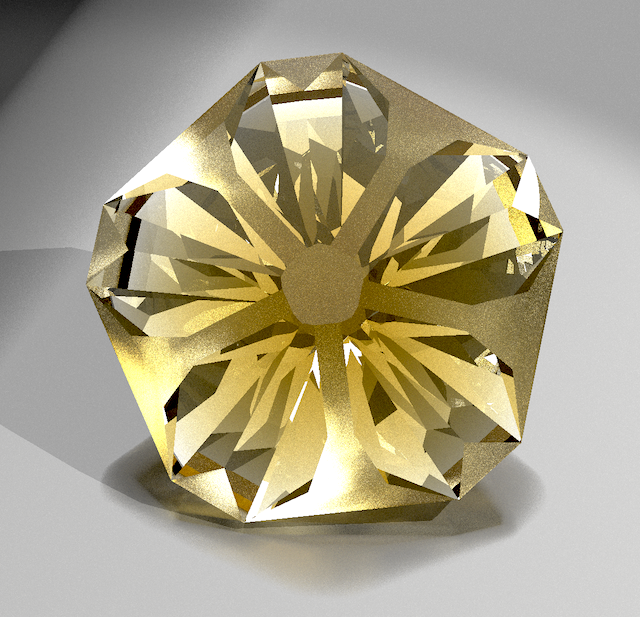
This image is made in ProFacet using the upcoming path tracer. Explore more designs in our Gallery.
The interactive slicer in ProFacet is your primary tool. Drag facets, adjust girdles, and watch the studio write FSL in real time. For most designs you never need to type a command, yet the language is always there when a peculiar cut or unconventional meet point demands it. That balance keeps experimentation fun without hiding the machinery that makes a stone reproducible.
When it is time to push performance, the Optimizer takes over. It speaks FSL natively, so you can tag any parameter and let the engine chase brightness, contrast, and scintillation using a modern metaheuristic evolutionary search. Under the hood, ultra-optimized GPU algorithms evaluate candidates faster than a human can pour water into a drip tank, but the controls stay simple: pick targets that matter, set sensible bounds, and let the system converge.
Contact
If you have questions, feedback, or need support, reach out to us at jon@profacet.com.
Timeline
- Test Phase: now through 1 Mar 2026—iterate, gather feedback, and refine the tools and documentation while everything is still in flux.
- Contest Window: 1 Mar – 1 May 2026—run the launch performance contest and keep the Hobbyist tier free so every cutter can participate.
- Paid Phase: begins 1 May 2026—introduce billing for the Analyzer, Optimizer, Pathtracer and Cloud Sync. The "offline" modus without these tools will stay free to use.
Don't be discouraged by the apparent complexity of FSL. Those advanced constructs are there to support complicated, parametrized girdle outlines (like ovals) or intricate patterns like checkerboards. Most designs never use any of that. FSL allows you to describe any faceted convex shape, and that power comes with some inherent complexity.